In London’s Mayfair, beyond the fashion houses and gold emporiums, stands the Royal Institution (RI): this old centre of British science now finds itself caught in a flashing current of Rolexes and Bentleys.
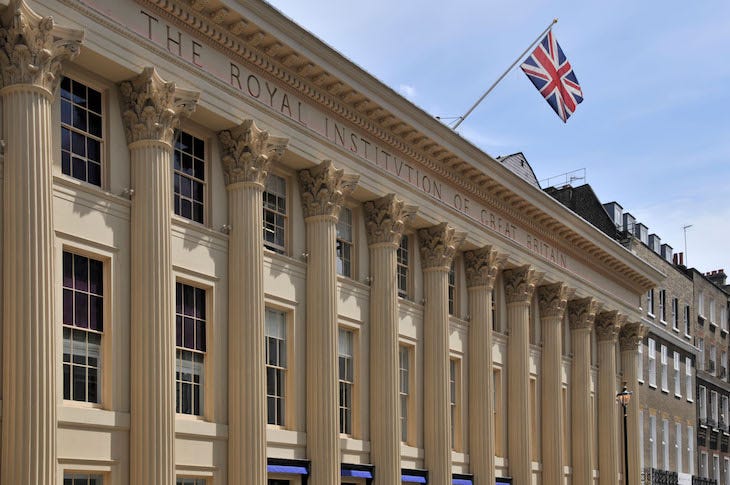
But go up to Faraday’s old apartment on the second floor of 21 Albemarle Street, and you’ll find a stranger heaven, a new research unit making fundamental breakthroughs in knowledge — the London Institute for Mathematical Sciences (LIMS).
This upstairs flat has barely changed since Faraday shut the door. For much of the 20th century, it was the grace-and-favour apartment for a sinecure: President of the Royal Institution, and these rooms hosted little real research activity for at least two decades.
That changed during Covid. In 2021, fifteen leading mathematicians and physicists moved in, and now call Faraday’s old home their headquarters. Operating a strict in-person culture, they form the leanest possible edition of a research institute: no students, no committees, no admin nor politics.
The fifteen were brought in from every corner of the globe by the electric figure of its founder Thomas Fink. Drawing elite researchers from America, Russia, Ukraine and China, with national and mathematical passports to divide the lot of them, they unite on a single mission: to advance the frontiers of maths and theoretical physics.
Since 2011, Fink has led the Institute in an unlikely arc against economic gravity, surviving a vacuum between government funding, applied science grants and startup capital. Blue-sky research is, by definition, hard to compute or predict ahead of time — and that makes it extraordinarily hard to sell.
So money flows to lower-risk, lower-return work instead. And it’s precisely this tendency, to focus on computable and tractable gains, which limits our civilisation’s progress.
I remember hearing an account of Hubert Dreyfus’ visits to the famous MIT research lab that read “Artificial Intelligence” above the door. But once inside, he found every researcher cautiously chipping away at small advances on well-cited papers.
He realised no one inside was actually working on intelligence.
The rest of academia displays similar deathly symptoms today: performance indicators (citations, publication volumes) often incentivise researchers to blunt their ambition, and focus on smaller wins.
Money is therefore evacuated to every cause except addressing the question of Fink: how do we deliver Faraday-grade breakthroughs in basic science?
“Basic, curiosity driven R&D has the large spillover effects for economic growth, exactly because the outputs aren’t withheld. Applied and Defence R&D have fewer spillovers. Yet both private and public funders have been shifting to the applied end of the scale …”
— Ananyo Bhattacharya, Chief Science Writer at LIMS and author of New York Times bestseller The Man from the Future, the definitive biography of John von Neumann
The Question of Fink
To old status hierarchies, Fink makes little sense.
In 2011 he turned his back on universities, now caught in a compromise between research impact and degree issuance. Dulled by moral theatre, and inflating away their standards as students moved from apprentice to customer (UK tuition fees were introduced in 1998 and later hiked), universities sacrifice their best minds on customer service and admin.
Nor could a startup give Fink the impact he seeks. Fink knows today’s Tech Titans may soon lie forgotten, like the imperial palaces whose remains spill out from under Rome. Being mostly electrons, the empires of Meta and Google and Microsoft will vanish only quicker.
In this way, the founder of LIMS is so like his predecessor at 21 Albemarle Street: though Fink and Faraday are scientific opposites (theoretician versus experimentalist), in every other way Fink is Faraday’s heir. He demands to outlast the age, seizing knowledge over wealth, every time.
He’s immunised LIMS against every distraction and cheap incentive. He impresses on his charges a new urgency to haul forward the frontiers of physics, which hasn’t moved measurably closer to a unifying ‘theory of everything’ since the 1970s.
“This,” says Fink, “is where the best minds come to do their life’s work”. He wears that refrain like an amulet. The Texan aggressor in him pre-empts you, in case he catches you planning to pervert the Institute with commercial grift.
Who is Fink?
Fink, by requirement, is odd.
This American with a half-English accent is perhaps the most British thing in Mayfair. Part professor, part soldier, he shuttles round the rooms where his fellow researchers work in quiet contemplation. He’s a character Douglas Adams wrote twice — world-builder Slartibartfast, and the buccaneering Beeblebrox.
A graduate of Caltech, he took his PhD at Cambridge and did post doc work at the Cavendish and ENS. In 2011, his frustration with rising inertia in elite universities boiled over into action. He resigned his sought-after fellowship at Cambridge to start something Britain strangely lacked — a dedicated place for fundamental knowledge creation in maths and physics, managed outside the university system.
In money and science, he’s bent the universe towards his will for fifteen years, performing repeat financial rescues before the lights go out.
LIMS: A Future Secured
Whilst backers of the Institute have ranged from US defence to hedge funds and technologists, grants to LIMS rarely saw it through more than a bad winter or two: never enough to grant it permanence.
But after fifteen years, Thomas Fink breathes a sigh of relief. At LIMS’ annual candlelight dinner last November, his vast energy flickers — he pauses on a well of recollected terrors, as he announces, hardly believing it’s true, that LIMS’ sequence of near-deaths has ended.
The Institute is here to stay — permanent at last — following a large gift made by tech founder Ben Delo, who has put this fifteen-person supercell on course to build an endowment as large as the fifteenth-century University of Aberdeen.
A Tour of the Institute
The focussed tropic of LIMS hits you the moment the door swings back.
Georgian panelling borders blackboards inset into every wall. You’d be lucky to spot the same markings twice in a day, their contents turned over and over, after breakfast and lunch and evening drinks. It shows you the intensity of idea-sharing that goes on here, unlike many faculties where researchers are siloed into groups and offices, hiving off the wide cross-connections that unlock fundamental progress.
Just off the Old Post Room (the Institute’s entrance hall), and overlooking Albemarle Street, Fink’s desk gives him line of sight on everyone who enters here. His office echoes Churchill’s war rooms, cigars at the ready. His own research is stowed in a briefcase like nuclear codes.
On the walls of Fink’s office, homology sits half scrubbed-out alongside the bones of boolean neural nets, sketching possible editions of this mad universe we’ve been born into. The wildness of the chalk markings suggests Fink contemplates the abyss in more than his physics.
Walk into Faraday’s bedroom and you’ll find a condensed matter physicist decoding the stars. In the drawing room, a Russian evacuee sketches “recurrent memory transformers” on the spot where Faraday wound the first transformer on a ring of iron.
Later in the evening, LIMS might host Bhargava or Penrose, joining a long line of the world’s leading mathematicians who now pilgrim here.
LIMS, Uncomputable Outcomes, and a Beacon for the AI Age
I decided to back LIMS in 2025, just as the world was calling the end of time on human-led maths. Why?
First, the world’s so clearly forgotten that maths is a game played by people; in some sense, the first intellectual game the species played. Only humans, propelled by their own mortality, open and then relentlessly pursue problems for their own sake. The interleaving processes may very well be computational, yes, and AI creates a new baseline in output. But to start blue-sky research, to keep on hacking away at it for months or years — that is almost never economically rational, over any predictable time horizon.
And it’s most certainly not in the computable interest of a machine to solve the hardest problems — you can rarely forward-compute your chances of solving them, and even if you could, the only visible reward is $1m from Clay at best (OpenAI’s proof of Navier Stokes likely cost tens of millions or more — we call that a marketing budget).
Recall Wiles, who used his new tenure to start tackling Fermat’s Last Theorem in the 1980s; most probably he was staking his whole life on a futile cause. Miraculously, he emerged seven years later with a proof that shattered the world of mathematics, and opened entirely new realms in algebra and geometry.
It’s these advances, those long-range campaigns in maths and physics with no computable outcome, which in time have unlocked substantially the whole modern world, on long enough horizons.
Second, maths is a haven of permanence in a mortal and wasteful world. At the risk of getting grand, it’s a kind of spiritual expression to its many followers, as anyone who’s played with abstract algebra knows. “Let α be a root of f(X)” is a prayer of creation (“let there be light, and there was light”). You can summon strange worlds and objects into existence, and expose them to logic, just like that.
And how often do those tools end up as yardsticks for the physical universe? So amazingly often. From space travel to communications and cryptography, Diophantine equations underpin every frontier of human venture.
But more importantly, I come to LIMS for the spirit of the place, to escape the pop culture of Silicon Valley. Though the Valley claims monopoly on optimism, and noisily valorises the saviour-founder, in 2026 it’s been a net exporter of fatalism to the world.
How ironic then that Thomas Fink, American captain of a non-profit in London, is the very visionary the Valley craves but rarely finds. He disputes that we’re locked in a losing struggle against AI. LIMS, he says, is “human first”. His focus on elite people doing hard mathematics is often confused for AI scepticism — meanwhile, his whole bench of mathematicians query Astra and Fable through the day and night.
But I think the Valley is now relearning what Fink’s been saying all along.
In this age of AI, as GPU-to-human ratios rise, we’re all going to have to understand the actual role of the global economy very much better. The economy’s purpose is not more robots, nor transport, nor financial spreadsheets, nor contracts — yes, these will be automated and automating. Computable endeavours, where the outcome is known and/or tractable before it is started — those will unquestionably fall to AI automation. The usual example: accountant fills in tax return, knows their charge-out rate and can accurately forecast the number of hours needed to do it. The machine displaces most of it.
But only the mortal human — thirsty for the eternal and evolved to please its fellow creature to improve its own survival odds — can endure the crushing uncertainty of unpredictable endeavour; only the human can keep going, when the chances of success cannot be computed ahead of time and the AI model would rationally halt.
So the answer to the post AI age is not in the fatalistic pop cult of YouTube hype merchants, selling singularity memorabilia in their whimsical one-liners, “the end of money”, “the end of work”, and so on.
Instead, it’s “give unto Caesar what belongs to Caesar, and to God what belongs to God”: GPU hours do what is computably profitable, and human hours to endure uncertainty when the AI would not justify proceeding. An AI, not body-bound and with little sense of mortality, cannot decide to keep going without knowing the RoI on the next whir of the GPU.
And by the way, you can see this conclusion implied already in venture capital allocation this year: until recently venture was backing software almost exclusively. But investors have violently reallocated, trimming their exposure to computable things like software, and rushed instead to the uncomputable physical edges of the world, backing systems where an RoI computation cannot be done. Venture is back, almost instinctively, to its original purpose.
In a similar way, the idea that Fink’s mathematicians should be sidelined by AI is comically faulty. It’s the very opposite: LIMS now finds its institutional attention relentlessly contested for by AI labs. Epoch AI doesn’t query Astra for new evaluations: instead, they fly LIMS researchers halfway across the world to set the next ones.
The leading labs know that, where frontier discovery’s concerned, the best possible pilots for their GPUs are the obsessives at Simons or the IAS or at LIMS. Once the low-hanging fruit of famous theorems is plucked, the marketing priorities of OpenAI and Anthropic will move on to other things.
Frontier discovery over time remains the prerogative of mad obsession. Only the most urgent mathematical aces can be trusted with whatever GPU budgets remain, to keep rolling back the frontiers of maths and physics.
Epilogue: My first visit to LIMS
I first visited LIMS in December 2024, the night of the FrontierMath evals.
At their festive drinks, I spoke with the Institute’s charismatic star researcher Yang-Hui He — one of the great bridge-builders between algebraic geometry and quantum field theory, and a repeat collaborator with CN Yang and Roger Penrose.
I asked him about the latest AI evaluations: was this the beginning of the end for human-led maths?
But he grinned, and said in his piping tenor, “Do you realise how many codimensions we’ve proved for Hodge? One! There are infinitely many to go. I need infinite post docs! I don’t fear being jobless. I fear not knowing in my lifetime.”
If Yang stared into the Mirror of Erised, I imagine he’d see something like Langlands completed. Not his own proof, I think. Just a proof — any proof — but most certainly an elegant one, whether authored by human or machine. I’m pretty certain that, in the final telling, it will be both.
What Fink has built in Faraday’s house is something unique and remarkable, a dock leaf to the nettle of Valley fatalism. I think LIMS may come to be recognised as the most impactful new institution in London today: a beacon for the unextractable human, from a city and a species being dealt their last rites on Twitter.
For the next great advances, keep your eye on 21 Albemarle Street.
To join or donate to LIMS, see their Endowment Page
Come to meet the researchers at one of their many weekday events.
My thanks to Ananyo Bhattacharya for his comments and suggestions on this piece.